
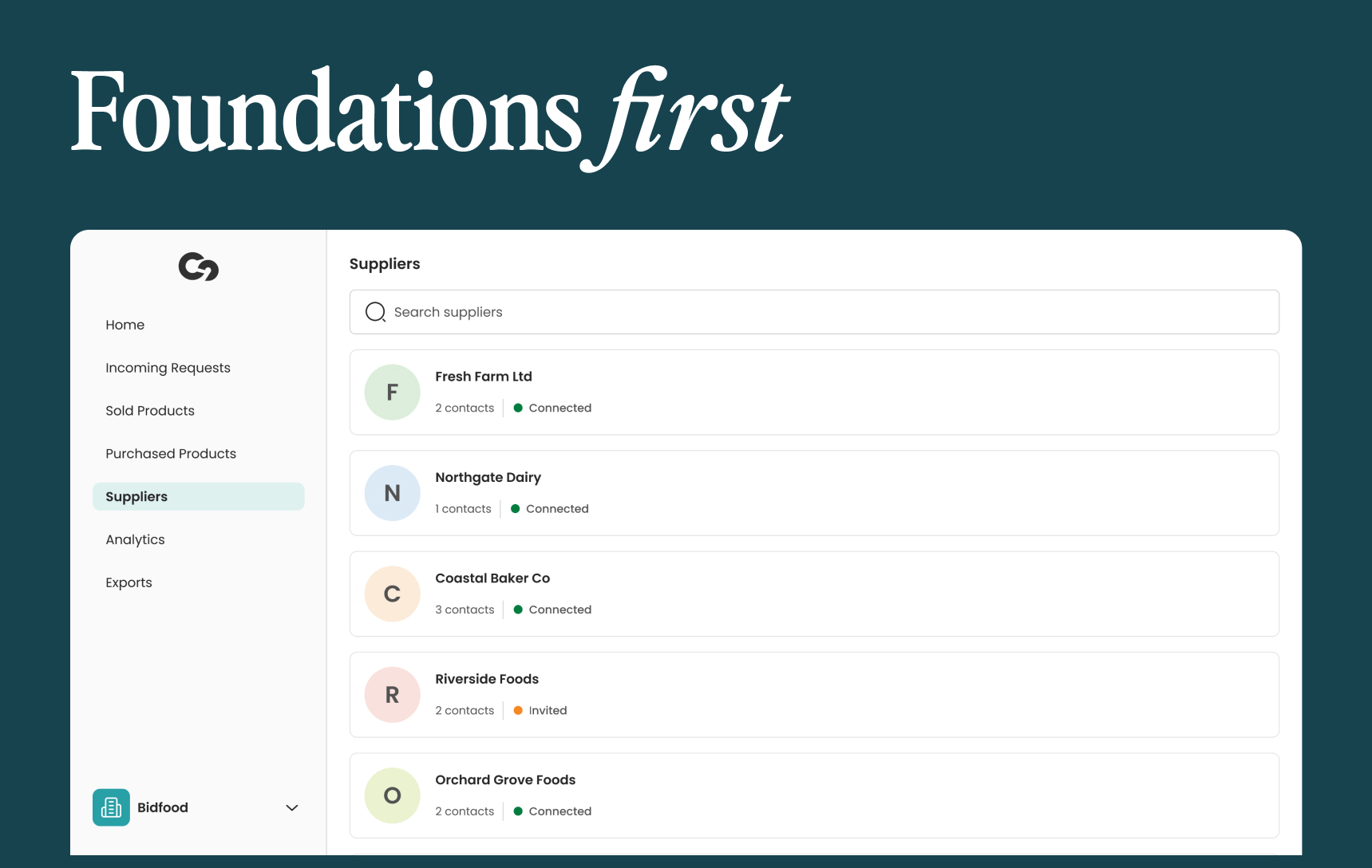
Getting suppliers to share primary climate data is one of the hardest things a food business can take on. It usually moves slowly, if at all. Bidfood’s experience has been different. In the first two weeks of inviting its first group of suppliers onto the CarbonCloud platform, more than half connected, and some have already started bringing their own ingredient suppliers in behind them. The reason isn’t a clever incentive. It’s groundwork.
Start with the foundations
Nathan Lyon, Head of Environmental Supply Chain Projects at Bidfood, likes a building analogy. Get the foundations right and the house stands. Rush it, and you spend years putting right what you should have done at the start. Bidfood invested 18 months on building the foundations before inviting a single supplier to act.
Scope 3 emissions make up around 97% of Bidfood’s total footprint, so the supply chain is where the real work sits. Bidfood began by modelling its own product range in the CarbonCloud platform, both branded and own-label lines, so that suppliers wouldn’t face a blank page. When a supplier is invited, an initial footprint for the products they supply to Bidfood is already there, ready to be reviewed and improved rather than built from scratch.
Meet suppliers where they are
The second part of the groundwork was understanding the suppliers themselves. Bidfood established an initial focus group consisting of key commodity suppliers and those driving 80% of their PG&S (Purchased Goods and Services) emissions. They then asked these suppliers to complete a short questionnaire about where they are on their own carbon journey: whether they had baselined their emissions, set targets, or measured product carbon footprints. That picture enabled Bidfood to tailor its support to each supplier’s starting point rather than adopting a ‘one size fits all’ approach.

“When I talk about a commercial approach, it’s not about a single incentive. It’s about understanding each supplier, where they are on their journey, their carbon maturity, and tailoring how we support them. That understanding has been built over years of working with suppliers in commercial roles.”
Nathan LyonHead of Environmental Supply Chain Projects, Bidfood UK
It’s a distinction that matters. A purely sustainability-led ask tends to treat every supplier the same. A commercial one starts from the supplier’s own situation and meets them there.
Make it easy, and make it collaborative
Bidfood was deliberate about keeping things simple. Suppliers received clear, staged communications, short pre-recorded webinars, a step-by-step user guide, and a single point of contact for any questions, all before they were asked to do anything in the platform. The message throughout was collaborative: this is a shared journey towards net zero, and here is a tool to help you take part.
That tool is offered at zero cost to suppliers. They can generate product carbon footprints for what they supply to Bidfood, watch the results improve as they add their own data, invite their own suppliers to contribute, and build readiness for growing regulatory and customer expectations. Their underlying activity data stays private. Only the calculated footprints are shared, so suppliers keep control of their commercially sensitive information.
Bidfood also made its commitment visible from the top. Alongside the platform invitation, suppliers received a signed letter from Bidfood’s Supply Chain and Technical Services Director, setting out why the initiative matters. Sponsorship from the Senior Leadership Team is a strong indicator that this is a core ask from the business, not ‘just’ a sustainability add-on.
A shared, long-term commitment
This is a long-term commitment, not a one-off data request. The first step is measurement, getting accurate product-level carbon data in place. The bigger goal is what comes after: using that data to reduce emissions, year on year. It is a journey Bidfood and its suppliers are on together, and one that neither can complete alone.
The direction of travel is clear. Customers increasingly expect transparency and demonstrable progress on emissions, and regulation is moving the same way. Bidfood answers to its own customers and, in time, to regulators, and its suppliers answer to theirs. Building this capability is becoming a requirement across the food industry rather than a ‘nice to have’, which is why Bidfood treats it as a shared responsibility rather than a request from one company to another.
There is real opportunity in getting ahead of it, and real risk in standing still. The businesses that put their data and their reductions in order, together, will be best placed to meet what their customers and regulators ask of them. Approached collaboratively, with the groundwork done and the tools provided, a growing obligation becomes a genuine advantage.
Early results
The response has been strong. Of the first group of suppliers invited, more than half connected within two weeks, and the questionnaire that came before it reached almost every supplier Bidfood works with directly.
Encouragingly, the effect is starting to reach further down the chain. Some suppliers have begun inviting their own ingredient suppliers, and the first of those have connected and are active too. The numbers of sub-suppliers are small for now, but the direction is exactly what Bidfood is working towards: a supply chain that comes online tier by tier.

“What Bidfood has understood is that suppliers engage when you meet them where they are and make it genuinely easy to take part. The groundwork Bidfood put in, modelling the range first, understanding each supplier, and keeping it collaborative, is why the engagement has moved at the pace it has.”
David BryngelssonCEO and co-founder, CarbonCloud
Challenges
This is undeniably a huge project, and like many sustainability projects, it’s not following a well-worn path, so there aren’t many other actors to follow or learn from. This project explores and pushes into new territories for both Bidfood and its suppliers. And like many projects, it’s the deliverables that are valued by stakeholders, rather than the journey. So, Bidfood’s challenge is to maintain the trust of stakeholders along that journey, with customers being a key beneficiary of the deliverables, but suppliers being the enablers; both are crucial. The Bidfood team are working on project updates for customers (both internal and external) as confidence is key.
What comes next
Bidfood is rolling out engagement in phases, learning as it goes and carrying each lesson into the next group of suppliers. The ambition is steady rather than rushed: bring the supply chain along at a pace that lasts, and turn better data into real emissions reductions over time.
It’s a model other businesses can learn from, and these learnings are applicable far beyond just the food industry. Do the groundwork, meet suppliers where they are, make it easy and collaborative, and the engagement follows.
If you are working to bring your own suppliers onto primary climate data, this is exactly the problem we built CarbonCloud to solve.
Are you curious to learn more about how your organization can measure, reduce, and prove the footprint of its range? Let us help.