
Scope 3 emissions management
Stand out among vendors with the climate footprint they are using
End-to-end transparency of supply chain emissions is top priority for retailers and food vendors. Seamlessly share your emissions data with them and help them highlight your food and beverage products as climate champions.

The Scope 3 emissions hunt
Food vendors are scouting for their supply chain emissions
The climate footprint of your supplied product is the holy grail
90% emissions for food vendors is deep in the supply chain and they have become painfully aware. That’s why harmonized supply chain emissions data has become the top priority –and highest climate risk– of food vendors worldwide. Only you, their supplier, can help vendors with their headache of gathering supply chain data.
Enter the digital infrastructure your vendors are already using and instantly stand out as a top performer.
The data from CarbonCloud allows us to focus on the things that truly matter. Now we want to collaborate with our suppliers and customers to reduce our climate impact together.
 Jonas Köhler — CEO at Menigo
Read more: Sysco Subsidiary Menigo applies CarbonCloud to 23,000 products
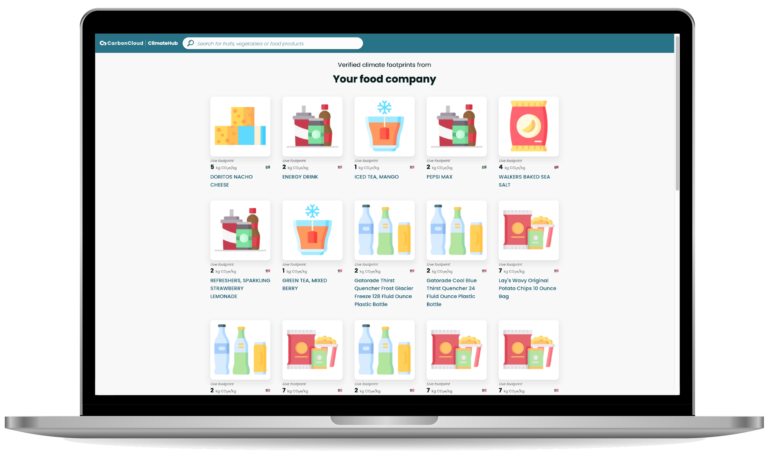
- No data harmonization
- No email exchanges
- No manual calculations
- No sharing of trade secrets or recipes
- Instant data propagation
- Full data comparability
Safely increase supply chain visibility
Connecting the food network for emissions reductions
Why are supply chain emissions important?
FOOD PRODUCERS ARE ON THE HUNT FOR SCOPE 3 EMISSIONS.
The majority of emissions for food products come from the deep end of the supply chain.
Consumer-facing food producers have less and less access to emissions data the further down the supply chain they go.
The less access they have to data, the less they can do to reduce the climate footprint and reach their climate targets. Your client knows that they will only reach their targets with your collaboration.
How can food & beverage suppliers help?
IT STARTS WITH YOUR INGREDIENTS.
Your supplied products are the next step in tracing emissions down the supply chain.
You can help your clients approach their climate targets by sharing the climate footprint of your products with data access you and only you have.
CarbonCloud makes this process fully automatic. Based on your data input, your climate footprint of your products is digitally calculated and the final footprint is shared digitally with your client on their end of the platform.
Why does my product have a carbon footprint assigned to it?
Your product may have a carbon footprint assigned for one of two reasons:
- You or your company added it directly to CarbonCloud - If you've worked with us to calculate your product's footprint, this represents your actual data.
- One of your customers is using CarbonCloud to calculate their Scope 3 emissions - If you haven't directly worked with CarbonCloud, your product may appear because one of your customers (wholesalers or retailers) needs to calculate emissions for their entire product assortment, including products they purchase from you.
In the second case, the footprint will be clearly marked as "Autogenerated from publicly available data" to indicate that you, as the producer, have not been involved in the calculation process. These footprints are emissions forecasts based on proxy data and category averages - they serve as placeholders until you choose to get involved in providing actual product data.
How is my product's carbon footprint calculated?
The calculation method depends on your level of involvement:
If you haven't been involved in the calculation (autogenerated footprint): Your product's footprint is calculated using top-level food category averages. This means we assign emissions based on the general food product category (e.g., dairy products, baked goods, meat products, beverages) rather than your specific product's actual production data. While this provides a reasonable estimate for Scope 3 reporting purposes, it may not reflect the unique characteristics of your ingredients, manufacturing process, or supply chain.
If you work directly with CarbonCloud: We calculate your product's footprint using your actual activity data, including specific ingredients, energy use, transportation, and packaging information - resulting in a much more accurate, product-specific carbon footprint.
The footprint seems too high/low for my product. Is this accurate?
If you're seeing an autogenerated footprint (marked as created from publicly available data), you're right to question this. Category-based calculations are estimates that may not accurately represent your specific food product. The footprint could be higher or lower than reality because:
- Your food production process may be more or less efficient than the category average
- Your specific ingredients or sourcing may differ from typical products in that category
- Your energy sources and production methods may vary
- Your transportation methods and distances may be different
- Your packaging choices may be more or less sustainable
- Your agricultural practices (if applicable) may have different environmental impacts
Can I get a more accurate footprint for my products?
Absolutely! You can significantly improve the accuracy of your carbon footprint by providing specific activity data about your products. This includes:
- Specific ingredients and raw materials used
- Sourcing locations and agricultural practices
- Energy consumption and energy sources in production facilities
- Food processing methods and efficiency measures
- Transportation modes (truck, ship, rail, air)
- Distances traveled from production to distribution
- Fuel types used for transportation
- Types of packaging materials used
- Weight and volume of packaging
- Recyclability and sustainability features
How do I provide this additional data?
Carboncloud can help you gather and input the specific activity data for your products. This will result in a much more accurate, product-specific carbon footprint rather than a category estimate.
To get started with improving your product's footprint accuracy, contact Carboncloud at: support@carboncloud.com
What are the benefits of providing more detailed data?
By providing specific activity data, you can:
- Get a more accurate carbon footprint that truly represents your product
- Potentially demonstrate that your product has a lower environmental impact than the category average
- Identify opportunities to reduce your actual carbon footprint
- Better communicate your sustainability efforts to customers
- Meet growing regulatory and customer demands for environmental transparency
Is there a cost associated with getting a more accurate footprint?
For specific pricing and service details, please contact Carboncloud directly at support@carboncloud.com. They can discuss options that work for your business size and needs.
How long does it take to get a more accurate footprint?
The timeline depends on the complexity of your products and how readily available your activity data is. Carboncloud can provide you with a more specific timeline when you contact them with details about your products.
I don't have all the detailed data you mentioned. Can I still improve my footprint?
Yes! Even partial data can significantly improve accuracy. Carboncloud can help you identify which data points would have the biggest impact on accuracy and guide you through the process of gathering available information.
What happens to my data?
YOUR RECIPE STAYS WITH YOU.
The data input you provide is uploaded and stored in and end-to-end encrypted folder.
Your data input is used exclusively to calculate the representative climate footprint of your products and is not shared with your clients or suppliers.
Your clients will only receive the final climate footprint as a fully calculated number without disclosing anything from your recipe, ingredients, processes, or secret sauce. The final footprint number will also remain hosted on ClimateHub, where you can share it with other clients who ask for it.
Food supply chain emissions on The Economist
Win the net-zero market with supply chain transparency
Climate transparency and emissions traceability in food supply chains is above all a business issue and a business opportunity. The Economist Impact highlighted CarbonCloud's insights and solutions on supply chain emissions transparency in a guest opinion blog written by our CEO & Founder, David Bryngelsson
How to: Supply chain engagement
From first-touch to primary data in weeks
It doesn't take months to complete the emissions map of a product. Let computers do the calculations and focus on making your products climate-smart and letting the world know.
- 1.
You: Input the data you work with on a daily
Simply list the portfolio data you already know by heart – product name, ingredients, country of origin, GTIN number.
- 2.
CarbonCloud: Automated emissions mapping
Automated mapping, our AI emissions mapping engine, scans your input, programmatically matches each product to its supply chain model, and calculates the climate footprint
- 3.
You: Get a shareable climate footprint
You get the climate footprints of your products with a shareable web report that substantiates the number, The climate footprints of your products are instantly shared with the vendors you work with.
- 4.
Your vendors: Increase emissions data quality
Vendors integrate your climate footprint in their emissions metrics and supply chain mapping, increase their emissions data quality, and package climate performance to consumers.
- 5.
You: Invite your suppliers to do the same for you
Send your suppliers an automatic invitation to provide their climate footprints. Your suppliers receive a notification and get onboard. You increase data quality from your point of view.
This shan't take long...
Ready to let the digital network solve the Scope 3 problem? Let's get started!
Getting started is hard – Make it easy for your organization and jump straight to the action. Reach out to our climate performance experts and see how you can jumpstart your climate strategy.